
Sump pump installation — Wikimedia Commons / CC BY-SA
A Tiered Approach to Moisture Management
Waterproofing measures for Canadian basements are generally organised from the least invasive to the most involved: exterior grading and drainage, crack repairs and damp-proofing, interior drainage systems, and finally full exterior waterproofing with excavation. The appropriate starting point depends on the nature and severity of the moisture problem, the foundation type, and the home's age and construction.
Before investing in interior or exterior waterproofing systems, it is worth confirming that simpler measures have been addressed. Improper grading and failed or disconnected downspout extensions account for a meaningful proportion of basement moisture problems and can be corrected at relatively low cost.
Exterior Grading and Surface Drainage
The slope of the ground immediately adjacent to a foundation determines where surface water flows after rain and snowmelt. Ground that slopes toward the house channels water to the foundation perimeter — precisely where it can exert hydraulic pressure against walls and find entry points. Correcting negative grade involves adding compacted fill against the foundation to restore a slope that directs water away from the building.
Clay or loam fill is preferable to gravel for this purpose, as porous materials can collect and hold water near the foundation. The corrected grade should slope away from the wall at a rate sufficient to carry surface runoff beyond the zone of influence of the footing drain, if one is present.
Downspout management is closely related. Eavestroughs that discharge at the wall, or that discharge into splash blocks positioned too close to the foundation, direct concentrated volumes of roof runoff to the most vulnerable part of the building envelope. Extensions or underground pipe runs that carry discharge beyond the saturated zone near the footing are a cost-effective measure.
Damp-Proofing vs. Waterproofing
Two Different Standards
Damp-proofing — typically an asphalt-based coating applied to the exterior of the foundation wall — is required by the National Building Code of Canada and is standard on new construction. It resists moisture vapour and minor water contact but is not designed to withstand sustained hydrostatic pressure. Waterproofing membranes, by contrast, form a continuous barrier capable of resisting positive water pressure and are specified where groundwater conditions are more demanding.
Crack Injection and Sealing
Vertical cracks in poured concrete walls — common products of concrete shrinkage during curing — are among the most frequent entry points for liquid water. Narrow shrinkage cracks can often be sealed with polyurethane or epoxy injection, which fills the crack through its full depth. This is a less invasive and less expensive approach than excavation when the crack is isolated and not associated with structural movement.
Cracks that are wider at the top than the bottom, that show displacement, or that are accompanied by inward wall deflection indicate structural stress rather than simple shrinkage and require assessment by a professional engineer before any waterproofing work is undertaken. Injection sealing a structurally compromised crack without addressing the underlying cause is not an appropriate long-term repair.
Pipe penetrations, the wall-floor joint, and window well perimeters are other common entry points that can be addressed with hydraulic cement or polyurethane caulk as part of a targeted interior sealing approach.
Interior Drainage Systems
Where liquid water actively enters the basement through walls or the floor slab, an interior drainage system provides a managed pathway for that water rather than attempting to block it entirely. These systems typically involve cutting a channel at the perimeter of the basement floor, installing a perforated drain pipe in a bed of gravel, and directing collected water to a sump pit where it is pumped to the exterior.
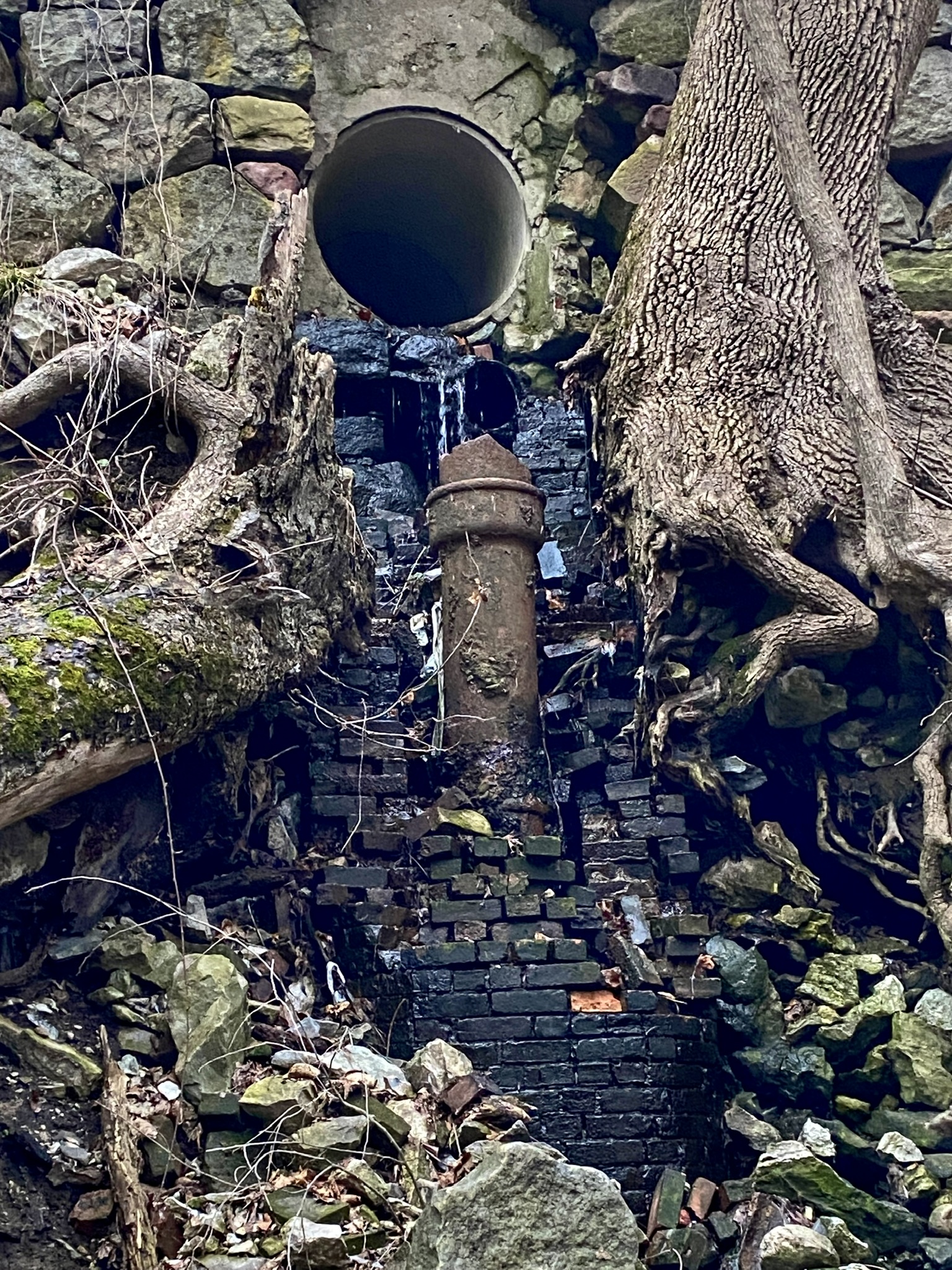
Perforated drainage pipe — the core component of both interior and exterior drainage systems — Wikimedia Commons / CC BY-SA
Interior drainage systems do not prevent water from entering the foundation; they intercept it before it reaches the main floor area. The advantage of this approach is that it avoids the cost and disruption of exterior excavation. The limitation is that water still makes contact with the foundation wall, which may contribute to ongoing deterioration of concrete or masonry over time.
Sump pumps require a power source and will fail during power outages unless a battery backup or water-powered backup pump is installed. Homes in areas with frequent or prolonged power outages, or with high groundwater tables, may warrant a backup system. The sump pit should be covered to prevent debris entry and to reduce evaporation of collected water back into the basement air.
Exterior Waterproofing
Exterior waterproofing addresses moisture at the source — before it reaches the foundation wall. It involves excavating to the footing, cleaning the wall surface, applying a waterproofing membrane, installing a drainage board and weeping tile (footing drain), and backfilling with free-draining granular material. This approach provides the most complete and durable solution for foundations subject to sustained groundwater pressure.
The cost and disruption of exterior waterproofing are significant: excavation requires access around the full perimeter of the foundation or the affected section, and landscape features, walkways, decks, and utility lines in the excavation zone must be managed. For this reason, exterior waterproofing is typically reserved for situations where the foundation is subject to chronic hydrostatic pressure and interior measures have not produced adequate results, or where the foundation is being exposed for other reasons.
The choice of membrane material varies. Sheet-applied membranes, spray-applied polymer membranes, and bentonite clay panels each have characteristics suited to different foundation types and site conditions. A contractor or engineer familiar with local soil and groundwater conditions is better positioned than general guidance to recommend the appropriate product for a specific site.
Vapour Barriers
For finished basement spaces, a vapour barrier on the interior face of foundation walls reduces the rate of vapour diffusion into the conditioned space and into wall cavities where it can condense. Polyethylene sheeting is the most common material. Building science guidance on vapour barrier placement in cold climates is nuanced: placement on the warm side of insulation is correct in heating-dominated climates, but the specifics of assembly detailing matter and have evolved in successive editions of the National Building Code.
Vapour barriers address vapour diffusion but not liquid infiltration. A basement wall with active water entry should not be finished with interior insulation and vapour barrier until the liquid moisture source has been controlled; doing so traps moisture in the wall assembly and accelerates deterioration of materials.
Maintenance Measures
A number of routine maintenance practices reduce the risk of moisture accumulation in Canadian basements without requiring significant capital investment. Keeping eavestroughs clear of debris ensures roof drainage functions as designed. Inspecting window wells for accumulated leaves and debris that can hold water against the foundation wall is worthwhile each spring and fall. Checking the sump pump annually before the spring snowmelt period, ensuring it operates correctly and that the discharge line is clear, is a practical precaution.
Monitoring basement relative humidity with an inexpensive hygrometer through different seasons identifies whether the humidity pattern is consistent with condensation (higher in summer), liquid infiltration (correlated with rain events), or year-round vapour transmission — each of which points toward a different primary response.
References
- Canada Mortgage and Housing Corporation — Moisture and Air Resources
- Health Canada — Dampness and Mould in Residential Buildings
- National Research Council of Canada — Construction Research Centre
Last updated: May 2026